Why Did Japan's Samurai Commit Seppuku? — The Origins of Bushido and the Warrior Age That Began in Kamakura | Rotem Tomita & Co. ブログ | Rotem Tomita & Co.
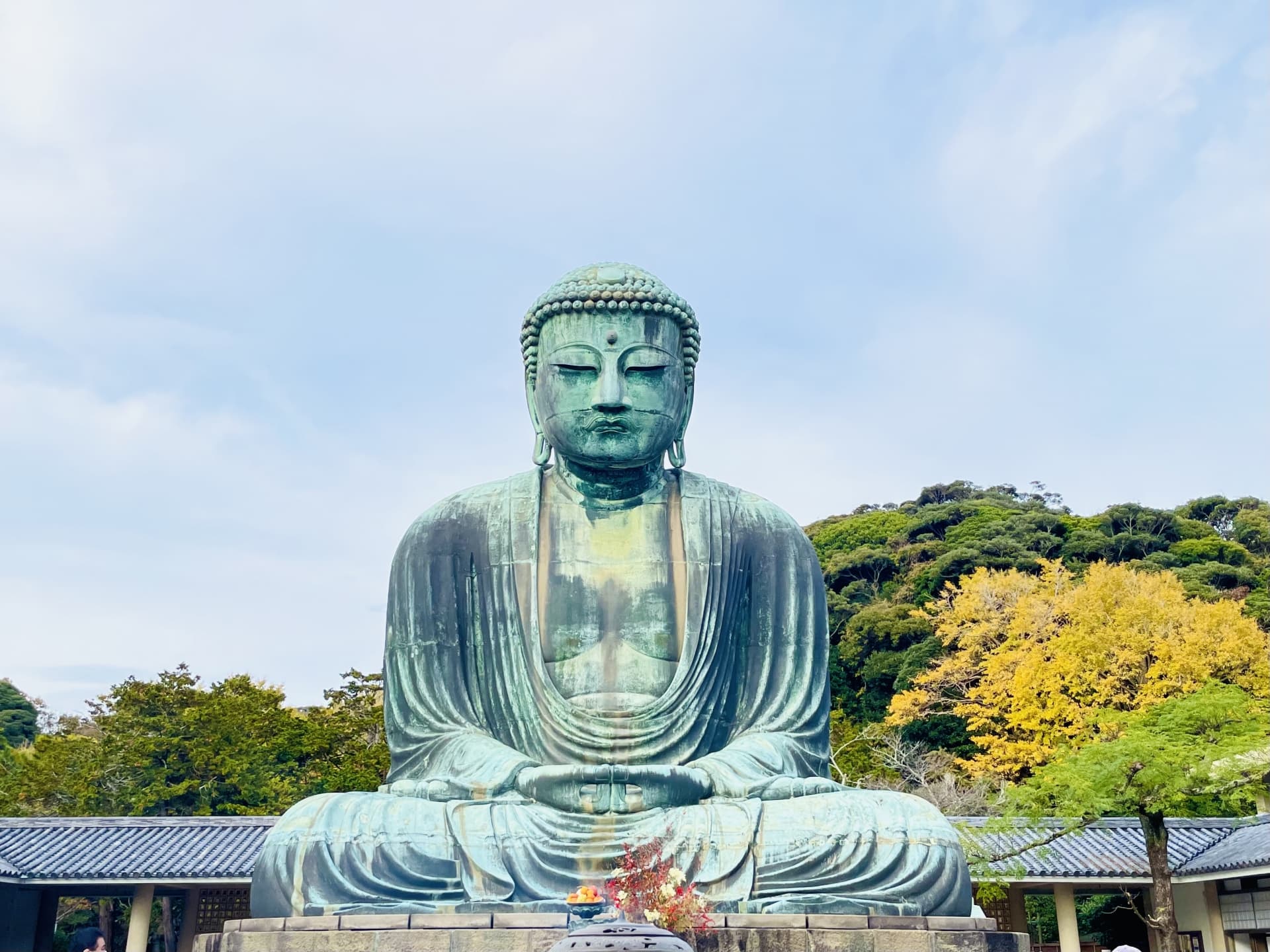
The Great Buddha of Kamakura (the Amida Buddha at Kotoku-in) is a bronze colossus about 11.3 meters tall, sitting under the open sky with no roof over its head. It was originally housed inside a great hall, but a typhoon in the 14th century destroyed the building, and it was never rebuilt. For over 600 years, this statue has sat outdoors, exposed to wind and rain.
But this article isn't really about the Buddha. It's about the town of Kamakura itself.
Kamakura is a small city enclosed by mountains on three sides and the sea on the fourth. Its current population is about 170,000. It's an hour by train from Tokyo. Tourists come for the temples and the beach.
But 800 years ago, this small town fundamentally changed the course of Japanese history. This is where the Kamakura Shogunate — the first military government run by samurai — was born, launching roughly 700 years of warrior rule.
Where Did the Samurai Come From?
Warriors Born from the Imperial Family
The origins of the samurai trace back to the imperial family itself.
During the Heian period (roughly 794–1185), the imperial house had a problem: too many children. If every son and grandson of the Emperor remained a member of the imperial family, the court's finances would collapse. The solution was to give some of them surnames — "Taira" or "Minamoto" — and remove them from the imperial register. This process was called sekiseki koka (臣籍降下).
Cut off from the imperial family, these men had little chance of advancement in the capital. So they moved to the provinces, cleared land, and armed themselves to protect it. This is how the samurai class was born.
In other words, the samurai were originally surplus population from the imperial household. People who branched off from the Emperor's family became armed groups, and eventually seized power from the Emperor himself. This dynamic is the starting point of the separation of authority and power discussed in "The Void at the Heart of Tokyo."
At first, the samurai were guard dogs for Kyoto's aristocrats. They suppressed provincial rebellions and maintained order in the capital — the dirty work. The nobility needed the samurai but looked down on them socially.
What changed was that the aristocrats started dragging the samurai into their own power struggles. The Hogen Disturbance of 1156 and the Heiji Disturbance of 1159 established a pattern: political conflicts in Kyoto were now settled by military force. The samurai's political influence surged overnight.
The Genpei War — Japan's Epic
The Rise and Fall of the Taira
After the Hogen and Heiji disturbances, the first samurai to seize power at court was Taira no Kiyomori. In 1167, he became the first warrior to hold the title of Daijo-daijin (Grand Chancellor, the highest rank at court). He married his daughter to the Emperor and wielded power as the Emperor's father-in-law.
"If you are not Taira, you are not human." This line, attributed to Kiyomori's brother-in-law Tokitada, has been passed down as the symbol of Taira arrogance.
What makes the Taira notable is that they were samurai who didn't act like samurai. Kiyomori was absorbed into Kyoto's aristocratic world and maintained his power through trade wealth. He ruled with money and marriages, not swords.
Minamoto no Yoritomo — The Man Who Chose Kamakura
The man who raised the banner of rebellion against the Taira was Minamoto no Yoritomo.
After his father Minamoto no Yoshitomo was killed in the Heiji Disturbance (1159), the 13-year-old Yoritomo was exiled to Izu province. He lived as a political exile for about 20 years. In 1180, when Prince Mochihito (a son of the retired Emperor Go-Shirakawa) issued a call to arms against the Taira, Yoritomo used this as his pretext to raise an army.
Yoritomo chose Kamakura as his base of operations. Why Kamakura and not Kyoto?
First, geography. Mountains on three sides, sea on the fourth. The only way in was through narrow mountain passes called kiridoshi — roads cut through the hills. A natural fortress.
Second, the eastern warrior networks. Yoritomo's ancestors had long maintained their power base in the eastern provinces. He needed the support of those eastern samurai clans.
Third, distance from Kyoto's aristocratic society. Taira no Kiyomori had been swallowed by Kyoto's court culture and lost his identity as a warrior. Yoritomo was determined not to repeat that mistake.
Yoshitsune and Yoritomo — The Hero and the Politician
The military hero of the Genpei War (1180–1185) was Yoritomo's younger brother, Minamoto no Yoshitsune. The Battle of Ichi-no-Tani (a surprise cavalry charge down a cliff), the Battle of Yashima, and the Battle of Dan-no-ura (1185, the final destruction of the Taira) — Yoshitsune's military genius is known to every Japanese person.
Yet after the war ended, Yoritomo turned on Yoshitsune, hunted him down, and ultimately drove him to suicide (1189). Why? The immediate cause was that Yoshitsune had accepted court titles directly from the Emperor without Yoritomo's permission. But the real issue was that a military hero couldn't be contained within the political power structure Yoritomo was building.
Yoshitsune is the most beloved tragic hero in Japanese history. The phrase hogan-biiki — rooting for the underdog — literally derives from his title. But from a political standpoint, Yoritomo's decision was ruthless yet rational. Power built on hero worship is unstable. What Yoritomo was trying to create was a system that didn't depend on any single hero.
Think of it this way: Israel's founding generation had its share of charismatic military leaders — Yigal Allon, Moshe Dayan. But Ben-Gurion understood that building a state meant subordinating military heroes to civilian institutions. When the Altalena affair forced a choice between a charismatic rival and institutional authority, Ben-Gurion chose the institution. Yoritomo faced a similar logic 800 years earlier.
The Kamakura Shogunate — A Political System Built by Warriors
Goon and Hoko: Favor and Service
In 1185, having won the Genpei War, Yoritomo appointed military governors (shugo) and land stewards (jito) across the country, establishing the Kamakura Shogunate.
The Kamakura Shogunate's governing principle was a simple contractual relationship called goon to hoko — favor and service. The Shogun guaranteed a warrior's land rights (favor). The warrior fought for the Shogun (service).
This is structurally similar to European feudalism. In Europe too, a king granted a knight a fief, and the knight performed military service in return.
One critical difference: the Kamakura Shogunate did not abolish the Emperor or the imperial court. The Shogun derived his legitimacy by receiving the title of Seii Taishogun (征夷大将軍) from the Emperor. He ruled by military force, but his legitimacy depended on the Emperor. This dual structure became the template for Japanese politics for centuries (for more, see "The Void at the Heart of Tokyo").
Seppuku — Why Did Samurai Choose to Die?
The Concept of an Honorable Death
Now we get to the real question. Why did samurai commit seppuku?
Seppuku — cutting open one's own abdomen — was considered the most honorable way for a samurai to die. Why the abdomen? In Japanese, the belly (hara) is the seat of emotions and will. Expressions like hara wo watte hanasu ("to split one's belly and talk" — meaning to speak frankly) and hara ga suwatte iru ("one's belly is settled" — meaning to have resolve) survive to this day. Cutting open the belly was the act of literally exposing one's inner self — the most extreme way to demonstrate one's innocence or resolve.
Seppuku first appears clearly in the historical record in the late Heian period. During the Genpei War era, defeated warriors increasingly chose to kill themselves rather than face the humiliation of capture. It was a personal decision — to protect one's honor, loyalty to one's lord, and family name.
Over time, seppuku became institutionalized. During the Edo period, seppuku was used as a form of punishment. When a samurai committed a crime, he was ordered to perform seppuku rather than being beheaded — granting him the opportunity for an honorable death. The procedure was formalized, with a designated kaishakunin (a second who would strike the final blow to shorten the suffering). It became a ceremony of death.
For Israelis, there's an obvious parallel: Masada. In 73 CE, the Jewish defenders of Masada chose to die rather than surrender to Rome. But the comparison reveals as much difference as similarity. At Masada, the decision was collective — an entire community chose death over enslavement. Seppuku was fundamentally individual. A samurai cut his own belly to prove something about himself: his resolve, his loyalty, his innocence. At Masada, what mattered was that no one would be taken alive. In seppuku, what mattered was how you died.
When Was Bushido Actually Born?
Here's an irony: bushido — the "way of the warrior" — was codified not when samurai were fighting, but when they stopped.
During the Kamakura and Sengoku (Warring States) periods, samurai fought for survival and profit. Betraying your lord wasn't uncommon. The emphasis on loyalty and honor under the name of bushido came during the Edo period — an era of peace. Warriors who no longer fought needed to redefine what it meant to be a warrior.
The most famous text is Hagakure (compiled around 1716). Dictated by Yamamoto Tsunetomo, a samurai of the Saga domain, it contains the line: "The way of the warrior is found in death." This doesn't mean samurai had a death wish. It means: think deeply about what you must do, abandon selfishness, and when the moment comes, don't hesitate to lay down your life.
It's similar to how the IDF's ethical code, Ruach Tzahal (Spirit of the IDF), was formulated not during the heat of the 1948 war, but decades later when the military needed to articulate its values in peacetime. Warriors define their code when they have time to think, not when they're fighting for their lives.
Walking Kamakura — What to Know to Enjoy It 10x More
Tsurugaoka Hachimangu
The central shrine of Kamakura. Yoritomo relocated it to its current site in 1180 and made it the spiritual anchor of the Kamakura Shogunate.
The approach road called Dankazura — a raised walkway running down the center of Wakamiya-oji — was built, tradition says, as a prayer for the safe delivery of his wife Hojo Masako's child. It uses forced perspective to appear longer than it actually is: wider at the entrance, narrowing as it approaches the shrine.
Beside the great stone staircase of the shrine is where the third Shogun, Minamoto no Sanetomo, was assassinated by his nephew Kugyo in 1219. A massive ginkgo tree once stood at the spot, but it fell in a windstorm in 2010. A young tree grown from its roots is now growing in its place.
Kenchoji
Founded in 1253, the first full-fledged Zen temple in Japan. Ranked first among the Five Great Zen Temples of Kamakura.
Zen Buddhism arrived in Japan and was embraced by the samurai class during the Kamakura period. Why did warriors take to Zen? Zen's emphasis on stripping away the unnecessary resonated with the samurai's pragmatism. Zen monks also brought the latest culture and knowledge from China. For the samurai, Zen temples were not just religious institutions but hubs of intellectual exchange.
The Great Buddha at Kotoku-in
The Kamakura Great Buddha mentioned at the start of this article. Construction began around 1252.
You can go inside it (extra charge: 50 yen). From the inside, you can see the casting seams and traces of repairs — nearly 800 years of history you can literally feel.
The Kiridoshi Passes
The mountain passes that were the key to Kamakura's defense — narrow roads carved through the surrounding hills. Seven are known (the "Seven Mouths of Kamakura"), including Asaina Kiridoshi, Nagoe Kiridoshi, and Kewaizaka Kiridoshi. They also make for great hiking trails.
Walking through a kiridoshi, you can feel why Kamakura worked as a fortress. Some passages are barely wide enough for two people to pass each other — nearly impossible for a large army to push through.
Inamuragasaki
In 1333, Nitta Yoshisada, who would destroy the Kamakura Shogunate, is said to have broken through along the beach at Inamuragasaki at low tide to storm the city. Legend has it that Yoshisada threw his sword into the sea as an offering to the dragon god — but in reality, it was probably a calculated military decision to exploit the tide.
The sunset from here is one of Kamakura's most beautiful sights. On a clear day, you can see the silhouette of Mount Fuji.
Closing — The Legacy of the Samurai
Kamakura today is a tranquil tourist town. Old temples, hydrangea-lined paths, the Shonan coast. But in this small place, the course of Japanese history was fundamentally altered.
Once the samurai seized power, Japan became a society where military government was the norm. From 1185 to 1868 — roughly 700 years. This long experience imprinted values on Japanese society: endurance, discipline, an obsession with honor, and loyalty to the group.
The willingness to choose death for the sake of honor, symbolized by seppuku, is one of the forces that has driven Japanese history — for better and for worse. Whether it's beautiful or cruel depends on where you're standing.
The Great Buddha of Kamakura has watched all of this, without a roof, for 500 years.
Access: 10-minute walk from Kamakura Station (recommended: walk along Wakamiya-oji and the Dankazura)
Kenchoji
Admission: Adults 500 yen, elementary/junior high students 200 yen
Hours: 8:30–16:30
Time needed: 30–60 minutes
Access: 15-minute walk from Kita-Kamakura Station
Kotoku-in (Great Buddha)
Admission: Adults (junior high and above) 300 yen, elementary students 150 yen (inside the Buddha: additional 50 yen)
Hours: Apr–Sep 8:00–17:30 / Oct–Mar 8:00–17:00 (last entry 15 min before closing)
Inside the Buddha: 8:00–16:30 (year-round; last entry 16:20)
Time needed: 20–40 minutes
Access: 7-minute walk from Hase Station on the Enoden line
Getting There
JR Yokosuka Line, Kamakura Station: approx. 1 hour from Tokyo Station
JR Yokosuka Line, Kita-Kamakura Station: close to Kenchoji and Engakuji
Enoden line: Kamakura Station – Hase Station – Inamuragasaki Station (enjoy the coastal scenery)
Nearby Recommendations
Hasedera (famous for hydrangeas; best in June)
Hokokuji (bamboo garden; quiet and beautiful)
Enoshima (about 25 min from Kamakura on the Enoden line; the whole island is shrines, observation decks, and eateries)
Komachi-dori (shopping street from Kamakura Station toward Hachimangu; great for snacking as you walk)
▶ Other articles in this series:
The Void at the Heart of Tokyo — Why a powerless Emperor has lasted 2,600 years. The Imperial Palace and the foundation of Japanese history
The Shogun Who Became a God — Why was Tokugawa Ieyasu enshrined as a deity after death? Nikko Toshogu and the man who built 260 years of peace
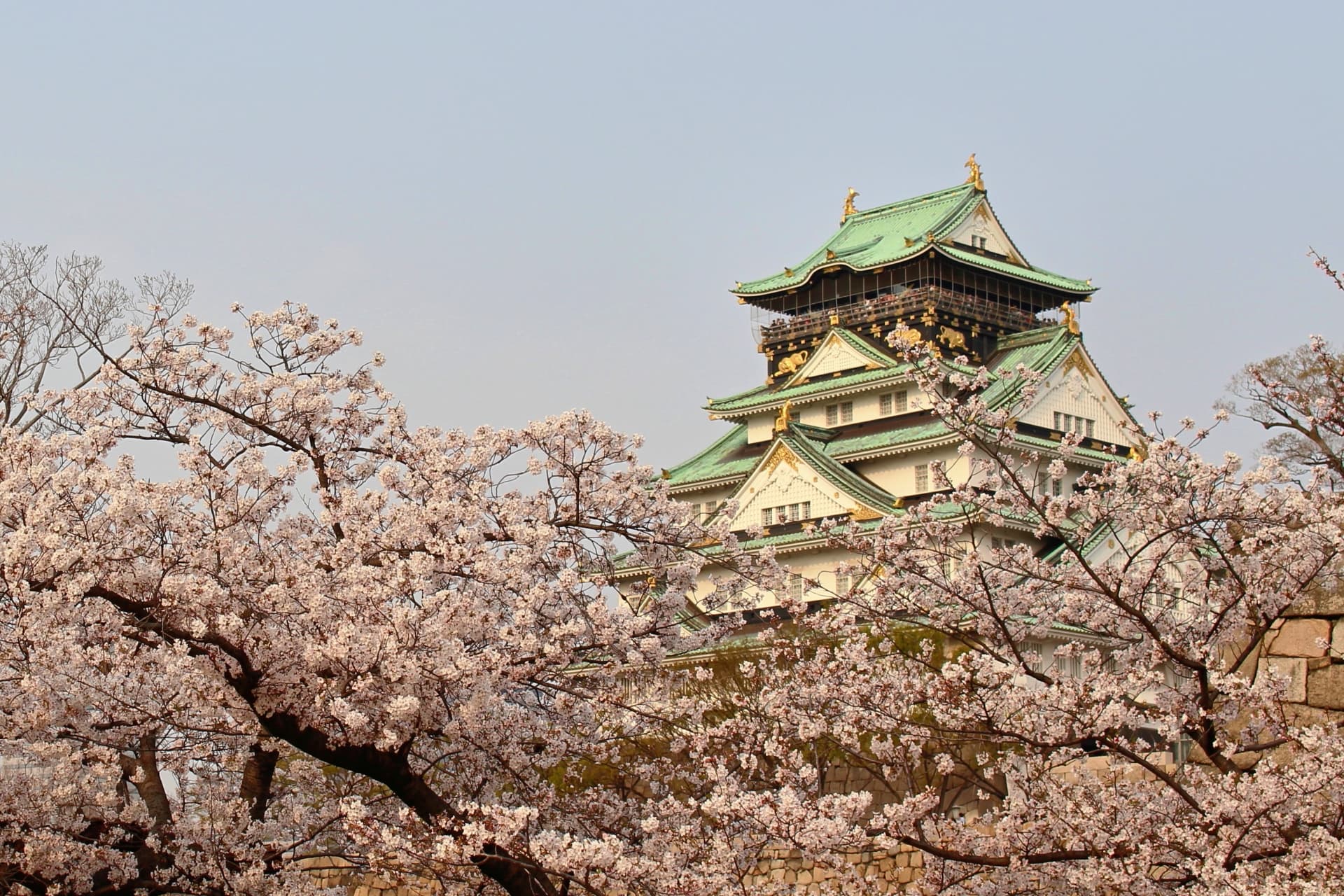
The Foot Soldier's Son Who Conquered Japan — Toyotomi Hideyoshi. From the lowest rank to supreme ruler. The greatest upset in Japanese history, carved into Osaka Castle
We strive for historical accuracy in this article, but the author is not a professional historian and some details may be inaccurate. Practical information such as admission fees and opening hours is subject to change — please check official websites for the latest details before visiting.