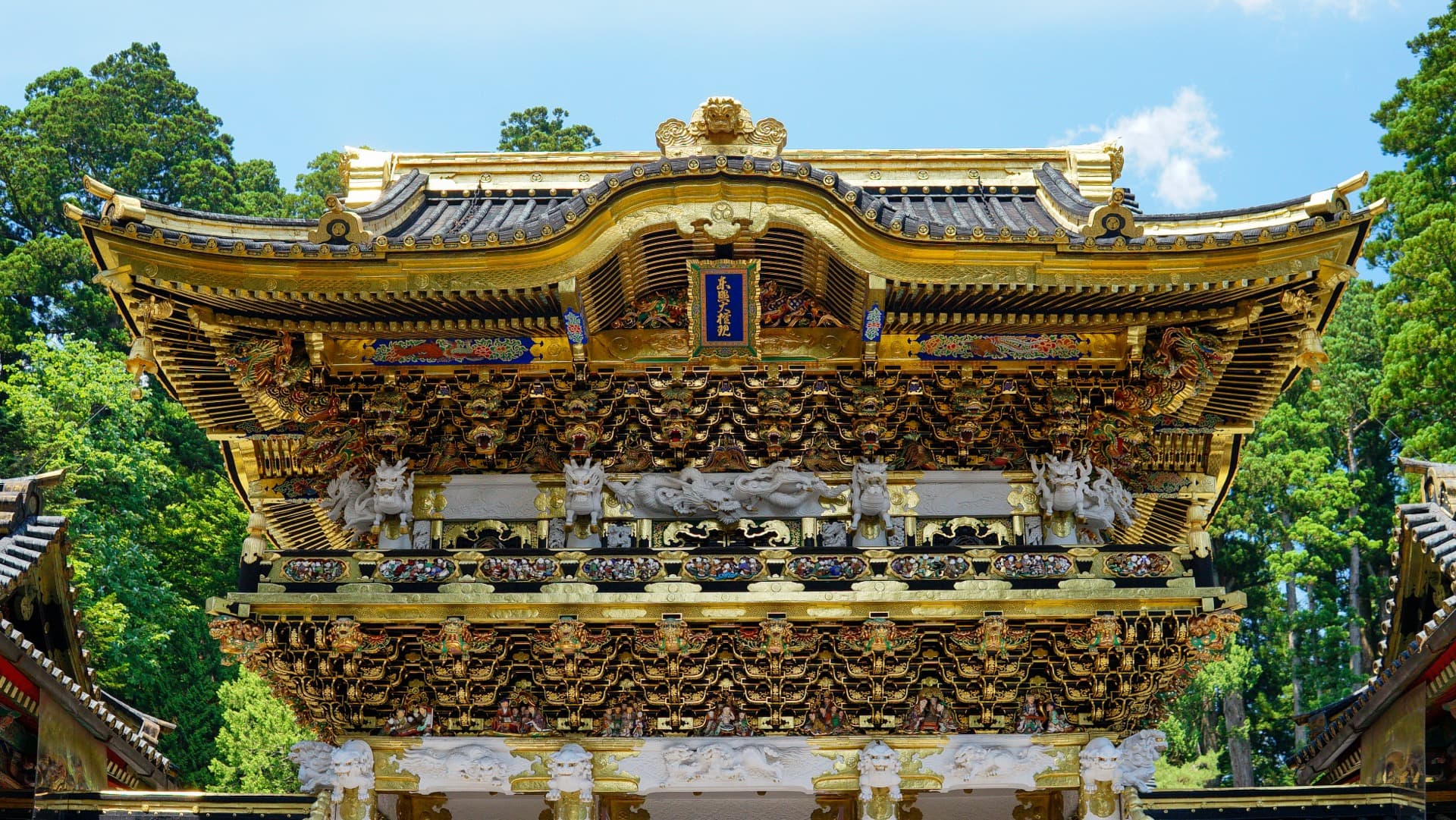
Stand in front of the Yōmeimon gate at Nikkō Tōshōgū, and the first thing you feel is overwhelmed. White and gold, polychrome carvings covering every inch of the gate — more than 500 sculptures packed onto columns and beams. Dragons, lions, phoenixes, flowers, human figures. The detail is so dense that you could stare at it all day and never get bored. That's why the gate has a nickname: Higurashimon — "the gate where the sun sets before you're done looking."
Behind this gate, Tokugawa Ieyasu is enshrined as a god.
Ieyasu was the warlord who unified Japan in the early 17th century and established a military government — the Edo Shogunate — that lasted 260 years. He died in 1616, but his dying wish was: "Enshrine me as a god at Nikkō." And that's exactly what happened. The Tōshōgū you see today was massively rebuilt in 1636 by Ieyasu's grandson, the third Shōgun Iemitsu. The total cost: roughly 568,000 ryō, equivalent to hundreds of billions of yen today.
Why could one warlord become a god after death? And why was a fortune the size of a national budget spent on building this dazzling mausoleum?
The answer is that Ieyasu was not merely a war winner. He was the architect of a political system that lasted 250 years.
The Man Who Waited
Japanese history has three great unifiers. Oda Nobunaga, Toyotomi Hideyoshi, and Tokugawa Ieyasu. Every Japanese person knows a famous set of poems about them:
"If the bird won't sing, kill it." (Nobunaga)
"If the bird won't sing, make it sing." (Hideyoshi)
"If the bird won't sing, wait until it does." (Ieyasu)
These poems were invented long after the fact, but they capture the three men's characters perfectly. Nobunaga carved a path with force. Hideyoshi moved people with cunning. And Ieyasu — Ieyasu waited.
A Childhood Spent as a Hostage
Ieyasu was born in 1543 in Mikawa province (modern eastern Aichi Prefecture), into a minor lordly family. At the time, Mikawa was a buffer zone squeezed between two major powers: the Oda clan to the west and the Imagawa clan to the east. Ieyasu's father chose to submit to the Imagawa, and six-year-old Ieyasu was sent to them as a hostage.
The actual path to hostage-hood was anything but simple, though. Ieyasu was first captured by the Oda clan and spent two years as their hostage before negotiations transferred him to the Imagawa. In the end, his time as a hostage with the Imagawa lasted about 12 years.
Many historians point to this hostage period as formative. In a situation where he had zero control over his own fate, Ieyasu learned patience and observation.
His Relationship with Nobunaga and Hideyoshi
In 1560, Imagawa Yoshimoto was killed by Oda Nobunaga at the Battle of Okehazama. Ieyasu seized his independence and formed an alliance with Nobunaga. For nearly 20 years after that, Ieyasu guarded the eastern flank as Nobunaga's ally.
An important point: Ieyasu's relationship with Nobunaga was an alliance, not submission. Ieyasu was not Nobunaga's vassal. That said, given the power gap between them, calling them equals would be a stretch — in practice, Ieyasu operated under Nobunaga's influence. At Nobunaga's behest, Ieyasu even had his own wife and eldest son Nobuyasu executed.
In 1582, Nobunaga was killed in the Honnōji Incident, and Hideyoshi moved swiftly to seize power. Ieyasu fought Hideyoshi once (the Battle of Komaki and Nagakute, 1584) and held the military advantage, but ultimately submitted to Hideyoshi's superior political maneuvering. Ieyasu went along with Hideyoshi's unification, and in return received vast domains in the Kantō region — including the land that would become Tokyo.
In 1598, Hideyoshi died. His heir was a five-year-old boy named Hideyori. Ieyasu saw this as the moment he had waited for all along.
After Hideyoshi's death, Ieyasu skillfully exploited rivalries within the Toyotomi regime, deepening his conflict with Ishida Mitsunari and others who wanted to preserve Toyotomi rule. On October 21, 1600, the two sides clashed at Sekigahara (in modern Gifu Prefecture).
This battle — considered the largest field battle in Japanese history — involved roughly 160,000 soldiers, yet it was decided in just six hours. Why? Because Ieyasu had been negotiating with commanders on the Western side well before the fighting started, undermining their cohesion before a single sword was drawn.
The defection of Kobayakawa Hideaki on the battlefield was decisive, but that wasn't the whole story. Many Western commanders simply didn't fight — they chose tacit neutrality by not actively engaging. Ieyasu won because he had already won before the battle began.
The Man Who Designed 260 Years of Peace
In 1603, Ieyasu was appointed Shōgun and established his government in Edo (modern Tokyo). But Ieyasu's real achievement wasn't winning the war. It was designing a system that made sure no war would ever happen again.
Why Edo?
Ieyasu didn't choose Edo by himself. In 1590, Hideyoshi ordered him to relocate to the Kantō region. Ieyasu left his ancestral Mikawa and moved to Edo — at the time, little more than a coastal swamp.
What matters is what happened after he won at Sekigahara. Ieyasu did not relocate to Kyoto or Osaka — the existing centers of power. He stayed in Edo. This was deliberate. A place with no existing power structure was exactly where he could build his ideal system from scratch. Ieyasu carried out massive landfill projects and river rerouting, transforming Edo into an enormous city protected by spiral moats.
The core of the governing system Ieyasu created — the bakuhan taisei (shogunate-domain system) — was designed to weaken the feudal lords and make rebellion impossible.
He distributed territories among roughly 260 daimyō (regional lords) and granted them a degree of self-governance. But at the same time, he built in multiple mechanisms to prevent any of them from rebelling.
The sankin-kōtai (alternate attendance) system was his greatest invention. Every daimyō was required to travel back and forth between Edo and his own domain every other year. Wives and children were required to live in Edo — hostages, in all but name.
The sankin-kōtai was ruinously expensive for the lords. They had to maintain processions of hundreds or thousands of retainers, staying at post stations along the highways. One study estimates that the Kaga domain (modern Ishikawa Prefecture) spent over 60% of its annual budget on sankin-kōtai-related costs. Without money, you can't maintain an army. The system nipped rebellion in the bud by draining treasuries.
Ieyasu also divided the daimyō into three categories:
Shinpan: Blood relatives of the Tokugawa house. Placed in strategic locations
Fudai: Lords who had been Tokugawa vassals before Sekigahara. Eligible for high positions in the Shogunate
Tozama: Lords who had opposed Ieyasu at Sekigahara or been late to his side. Given large territories, but placed far from Edo and excluded from Shogunate decision-making
Satsuma (Kagoshima), Chōshū (Yamaguchi), Tosa (Kōchi). The domains that would eventually topple the Shogunate were all tozama. Located in the western reaches, far from the center of power, they built up strength through independent trade and domain reforms. Ieyasu's system worked for 260 years. But when the time came, it was the tozama lords who broke it from within (more on this in "250 Years of Isolation, Then the Black Ships").
The Buke Shohatto — Turning Warriors into Bureaucrats
Ieyasu (technically promulgated under the name of the second Shōgun, Hidetada, and reinforced by the third, Iemitsu) issued the Buke Shohatto — "Laws for the Military Houses" — to tightly regulate daimyō behavior. Castle repairs required permission. Marriages between daimyō families without authorization were banned. Building large ships was prohibited.
In short, samurai were forbidden from independently building up military power, forming alliances, or expanding their influence. Warriors gradually became bureaucrats.
Why He Became a God
Ieyasu died in 1616. One of his dying wishes was: "Enshrine me at Mount Nikkō."
In Japanese religion, it's not unusual for a person to be enshrined as a deity after death. This might be hard to wrap your head around if you come from a monotheistic worldview. In Judaism, Christianity, and Islam, a human becoming God is blasphemy. But Shinto is polytheistic, and the concept of divinity is fundamentally different. Kami (gods/spirits) dwell in mountains, rivers, and rocks. An extraordinary person being enshrined as a deity after death is an extension of that same logic.
Ieyasu was given the divine title "Tōshō Daigongen" — "The Great Incarnation Who Illuminates the East." In other words, he became the god who protects Edo (the east).
The Tōshōgū you see today was built by his grandson, the third Shōgun Iemitsu. As a child, Iemitsu had faced a succession dispute with his younger brother, and it was Ieyasu's ruling that secured his place as Shōgun. Iemitsu's gratitude ran deep, and the massive reconstruction — costing the equivalent of a national budget — was an expression of that debt.
At the same time, the Tōshōgū served as a political instrument. A custom arose of daimyō from across the country making pilgrimages to Nikkō, turning it into a visible display of Tokugawa authority.
Walking Nikkō Tōshōgū — What to Know to Enjoy It 10x More
Yōmeimon (the Sun Gate)
The "Higurashimon" I mentioned earlier. All 500-plus carvings have meaning. Chinese legends, Confucian teachings, Taoist immortals. Every philosophy of the age is packed into this one gate.
Look closely and you'll notice that one of the 12 pillars has its pattern carved upside down. It's called the "inverted pillar," and it was done on purpose — based on the idea that perfection marks the beginning of decline. An intentional flaw.
Sanzaru (the Three Monkeys) — See No Evil, Hear No Evil, Speak No Evil
Three monkeys carved on the wall of the Sacred Stable (a horse shed). Known worldwide as "See no evil, hear no evil, speak no evil," but they're actually just one panel in a series of eight carved monkey scenes that depict a human life from beginning to end.
The "three monkeys" panel carries an educational message: while young, it's best not to see, hear, or speak of evil. Follow the eight panels in order, and you see monkeys going through birth, growth, setbacks, and enlightenment — a full human life.
Nemuri-neko (the Sleeping Cat)
A small carving at the entrance to the inner shrine (Okumiya), where Ieyasu's tomb lies. Attributed to the legendary craftsman Hidari Jingorō. A cat sleeping among peony blossoms. On the reverse side, sparrows are carved.
The message: the cat sleeps because the world is so peaceful. And because the cat sleeps, the sparrows can play without fear. A symbol of the era of peace Ieyasu brought about.
Okumiya (the Inner Shrine)
Climb 207 stone steps to reach Ieyasu's tomb. In stark contrast to the dazzling extravagance of the main shrine, the Okumiya is a quiet space with a single, unadorned bronze pagoda.
Turn around here, and through the gaps between towering cedar trees, you can see the Kantō Plain. True to Ieyasu's dying wish, he watches over Edo (Tokyo) from the north for eternity.
Ieyasu's Other Sacred Site — Zōjōji Temple
If Nikkō Tōshōgū is where Ieyasu exists as a god, Zōjōji Temple in Shiba, Tokyo, is where he exists as a man.
Zōjōji is the head temple of the Jōdo (Pure Land) sect of Buddhism. When Ieyasu first entered Edo, he designated it as the Tokugawa family's bodaiji — the temple that houses ancestral spirits. Six Shōguns are buried here.
Because it sits right next to Tokyo Tower, you get a striking visual: the vermilion Sangedatsumon gate (an early Edo-period structure that survived wartime bombing — a rare survivor) with Tokyo Tower jutting up behind it. It's one of those quintessential shots of Japanese tradition and modernity coexisting, and you'll see plenty of people photographing it.
What makes Zōjōji especially interesting is that it shows how Ieyasu played both sides — Shinto (Tōshōgū) and Buddhism (Zōjōji). In Japan, Shinto and Buddhism coexisted for centuries. The same person could be connected to both shrines and temples without anyone seeing a contradiction. It's hard to imagine from a monotheistic perspective, but the contrast between Zōjōji and Tōshōgū offers a clear window into Japan's religious flexibility — or ambiguity, depending on how you look at it.
Closing — The Philosophy of Control
In Israeli history, a king's legitimacy was rooted in a covenant with God. David was chosen by God, and his kingdom was said to endure by divine promise.
Ieyasu's approach was, in a sense, the exact opposite. Instead of relying on God's promise, he built a system based on the assumption that humans will betray each other. The sankin-kōtai drained the lords' finances. Wives and children were held hostage. Blood relatives and outsiders were treated differently. He built 260 years of peace on a cold-eyed understanding that people will betray you if given the chance.
And after death, he made himself a god. The system's architect became the system's guardian deity.
The dazzling Tōshōgū at Nikkō and the austere tomb behind it. The clan marks carved into the stone walls of Edo Castle. Tokyo Tower rising behind the Sangedatsumon gate at Zōjōji. The traces of the order Ieyasu designed are still visible in the Japanese landscape, 400 years later.
📍 Practical Information
Nikkō Tōshōgū
Admission: Adults & high school students ¥1,600, elementary & junior high students ¥550 (Tōshōgū only)
Combo ticket (Tōshōgū + Treasure Hall): Adults & high school students ¥2,400, elementary & junior high students ¥870
Treasure Hall only: Adults ¥1,000, elementary & junior high students ¥400
Hours: Apr–Oct 9:00–17:00 / Nov–Mar 9:00–16:00 (last entry 30 min before closing)
Time needed: 90–120 minutes
Access: Bus from Tōbu Nikkō Station, approx. 10 min. About 2 hours from Asakusa, Tokyo by limited express
Zōjōji Temple — Tokugawa Shōgun Family Mausoleum
Admission: Adults ¥500, high school students and under free
Closed: Tuesdays (open if Tuesday is a national holiday)
Time needed: 20–30 minutes
Access: 3 min walk from Shibakōen or Onarimon Station (Toei Mita Line). 10 min walk from JR Hamamatsuchō Station
Nearby Recommendations
Nikkō: Kegon Falls, Lake Chūzenji (20 min by car from Tōshōgū; especially beautiful during autumn foliage)
Nikkō: Futarasan Shrine (next to Tōshōgū; older history than the Tōshōgū itself)
Near Zōjōji: Tokyo Tower (right next door; observation deck with panoramic views of Tokyo)
Near Zōjōji: Shiba Park (green space in central Tokyo, blending into the Zōjōji grounds)
▶ Other articles in this series:
The Void at the Heart of Tokyo — Why a powerless Emperor has lasted 2,600 years. The Imperial Palace and the very foundation of Japanese history
The Foot Soldier's Son Who Conquered Japan — Toyotomi Hideyoshi. From the lowest rank to supreme ruler. The greatest upset in Japanese history, carved into Osaka Castle
We strive for historical accuracy in this article, but the author is not a professional historian and some details may be inaccurate. Practical information such as admission fees and opening hours is subject to change — please check official websites for the latest details before visiting.