Step Out of Tokyo Station, Then Look the Other Way
Walk out the Marunouchi exit of Tokyo Station. Office towers greet you: Mitsubishi, Tokio Marine, Japan Post. The nerve center of the Japanese economy. Now turn around and walk in the opposite direction. Within 200 meters, the skyscrapers vanish. In their place: a vast moat, stone walls, and behind them, a deep forest.
This is the Imperial Palace. Right in the middle of Tokyo's most expensive real estate, inside the Yamanote Line loop, roughly 115 hectares sit quietly — 2.5 times the size of Tel Aviv's Yarkon Park. One family lives here. The Emperor's family.
Why does such an enormous void exist at the center of the world's most expensive city?
To answer that, you need to touch the very foundation of Japanese history. And once you understand it, everything you see on your trip to Japan will look different.
What Is an Emperor? — Not a King
For Israelis, the image of a king is clear. King David, King Solomon — they led armies, handed down judgments, ruled nations. European kings mostly did the same.
The Japanese Emperor is fundamentally different.
His role is closer to a Kohen Gadol (High Priest). A ritual figure connecting the divine and human worlds. In Shinto, Japan's traditional religion, the Emperor is considered a descendant of Amaterasu, the sun goddess. This is mythology, but what matters is that the story has never been broken for over 2,600 years.
Let's compare. Israel's Davidic dynasty lasted about 400 years before it ended. Denmark's royal house, the oldest in Europe, goes back roughly 1,100 years. Japan's imperial family, even excluding the mythological first emperor, has continued unbroken for at least 1,500 years.
Why?
First, because Japan is an island nation. The Davidic dynasty fell to an external enemy: Babylonia. Many European dynasties were ended by foreign invasion. The Japanese archipelago has faced large-scale foreign attacks only twice in its history — the Mongol invasions of 1274 and 1281 — and repelled both. The sea acted as a natural barrier, blocking the kind of external forces that could destroy a dynasty.
But that alone doesn't explain it. Even without foreign enemies, dynasties can be overthrown from within. Nearly every Chinese dynasty was destroyed by internal rebellion or rival domestic forces. Japan, too, had plenty of warlords stronger than the Emperor. Why didn't any of them take the throne?
The answer is probably that the Emperor held no power.
A Nation Where Authority and Power Separated
The defining theme running through all of Japanese history is the separation of authority from power.
The Emperor remained the nation's authority — the source of legitimacy — but actual power was always in someone else's hands. In the Heian period, the Fujiwara clan held it. From the Kamakura period onward, military commanders called Shoguns governed in the Emperor's place.
This wasn't unique to Japan. In the Islamic world, from the mid-Abbasid period onward, the Caliph (religious authority) lost real power to the Sultans of the Buyid and Seljuk dynasties (military strongmen) who actually ran things. In the Christian world, the tension between the Pope and secular kings and emperors lasted for centuries.
What was unusual about Japan was the extraordinary stability of this arrangement. In the Islamic world, the Abbasid Caliphs suffered a devastating blow when the Mongols sacked Baghdad in 1258. The title of Caliph survived under the Mamluks and the Ottoman Empire, but it changed hands repeatedly and was finally abolished by the Turkish Republic in 1924. In Europe, the balance between pope and king swung violently from era to era. In Japan, the same family — the imperial house — was always there. Power holders came and went. The source of authority never moved.
Why? The island geography blocked external enemies, as I mentioned. But what about internal reasons?
First, there was no incentive to topple the Emperor. The Emperor had no land and no army. Overthrowing him would gain you nothing. In fact, being able to say "the Emperor appointed me" gave your rule legitimacy. The Emperor was the most convenient legitimacy device a ruler could have.
Second, a structure for exploiting the imperial bloodline had taken hold. Some early warrior leaders descended from members of the imperial family who had been given the surnames "Minamoto" or "Taira" and removed from the imperial register (a process called sekiseki kōka). In practice, though, only a minority of samurai truly had imperial blood. Most came from provincial clans who, after seizing power, fabricated genealogies claiming descent from the Minamoto or Taira. Tokugawa Ieyasu claimed Minamoto lineage, but he actually came from the Matsudaira, a minor clan in Mikawa province, with unknown origins before that. In other words, the blood connection to the Emperor wasn't a reason to protect the Emperor — it was a tool for borrowing the Emperor's authority. If you destroyed the Emperor, you lost the tool. This is the flip side of the first reason.
Unassailable from outside, untoppled from inside. These twin conditions made the imperial house the longest-lasting dynasty on earth.
The story of how this separation of authority and power began lies in Heian-era Kyoto. I'll cover that in detail in "The Emperors Who Gave Up Power."
600 Years in This Place
Back to the Imperial Palace. What you see today was not always the Emperor's home.
In 1457, a military commander named Ōta Dōkan built a small castle on this spot. Edo, as the area was then known, was nothing more than a seaside swamp.
In 1590, Toyotomi Hideyoshi — on the verge of unifying all Japan — ordered Tokugawa Ieyasu to relocate to the Kantō region. It was a political move: severing Ieyasu from his ancestral lands in Mikawa (modern eastern Aichi Prefecture) and pushing him far from the power centers of Kyoto and Osaka. Ieyasu took this swampy land and transformed it, undertaking massive civil engineering works to carve spiral moats and raise walls, turning Edo Castle into Japan's largest fortress. After winning the Battle of Sekigahara in 1600 and claiming supremacy, he stayed in Edo rather than moving to Kyoto or Osaka. Why a new ruler chose to avoid the existing centers of power — that's a story for "The Shogun Who Became a God."
In 1603, Ieyasu was appointed Shōgun, and the Edo Shogunate was born. For the next 265 years, Edo Castle was the center of power in Japan.
In 1867, the fifteenth Shōgun, Tokugawa Yoshinobu, returned political authority to the Emperor (the Taisei Hōkan). The following year, 1868, the Meiji Restoration began. The Emperor moved from Kyoto to Tokyo. The Shōgun's castle became the Emperor's palace.
But the Meiji Restoration didn't mean the Emperor seized real power. It was low-ranking samurai from the Satsuma and Chōshū domains who had championed the Emperor, and they were the ones who held real power in the new government. The Emperor was, once again, used as a symbol of authority. Only the vessel changed — from the Shōgun to the Restoration leaders. The structure stayed the same.
Walking the Imperial Palace — What to Know to Enjoy It 10x More
Knowing the history transforms what you see when you walk around the palace grounds.
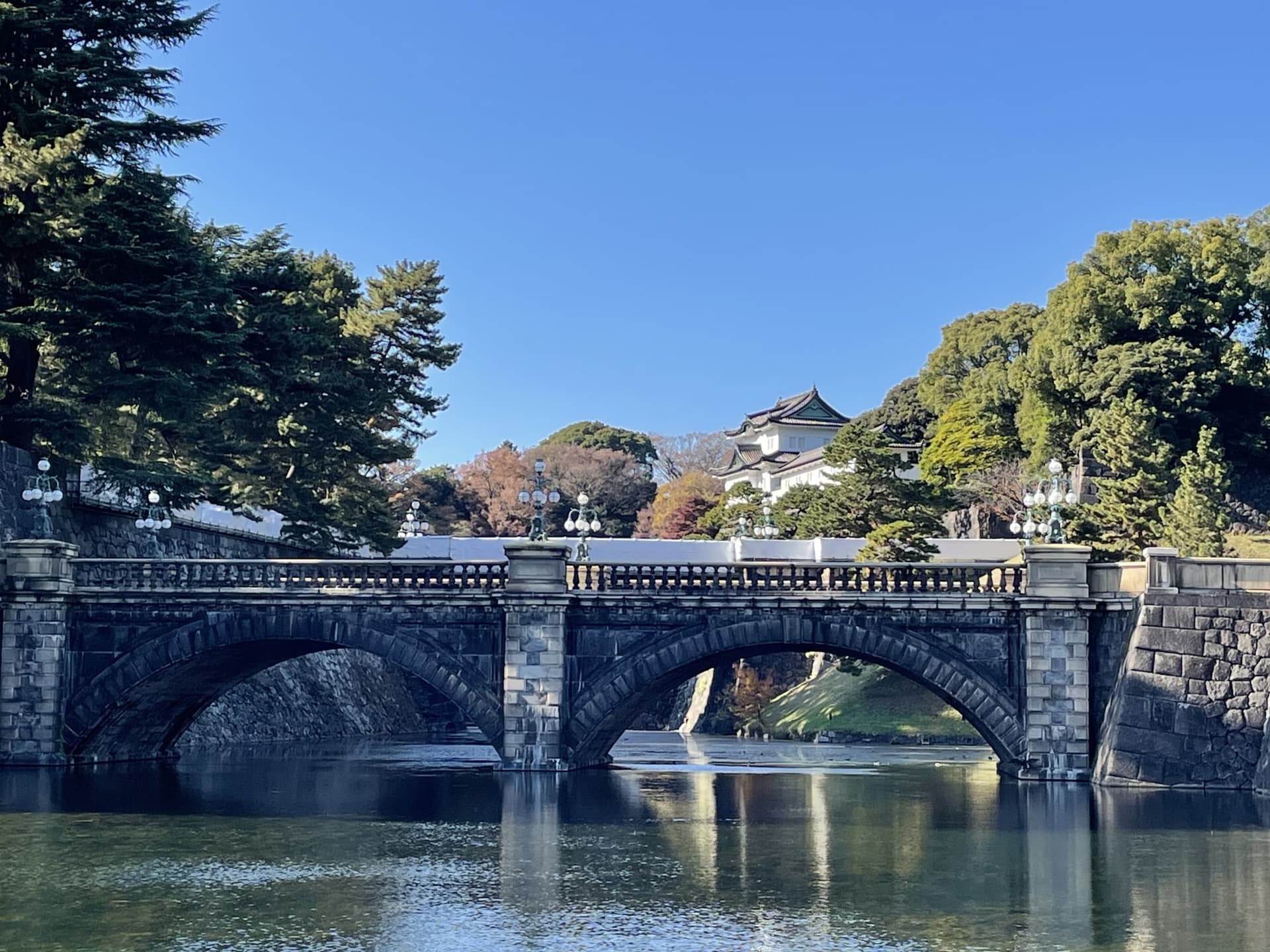
Nijūbashi (Double Bridge)
The bridge at the main entrance to the inner palace. A classic photo spot for tourists, but beyond this point, ordinary people cannot enter (except during guided public tours and the twice-yearly New Year and Emperor's Birthday public appearances). The very fact that you can't enter embodies the Emperor's authority — approachable but untouchable.
East Gardens (Higashi Gyoen)
You can't get past the inner bridge, but the East Gardens are free to enter. This is where the main keep of Edo Castle once stood.
The stone platform of the castle tower (tenshudai) remains. Standing on it, you can imagine just how enormous the original tower must have been. The tower itself burned down in the Great Fire of 1657 and was never rebuilt. The staggering cost of rebuilding after the fire — which consumed most of Edo — left nothing for the tower. The symbol of power vanished, but its foundation has remained for nearly 400 years.
Ōtemon (Main Gate)
The main gate of Edo Castle. Look closely at the stone walls. On the surfaces of the massive stones, you'll find circles, triangles, and symbol-like engravings. These are identification marks from the tenka bushin system, in which the Shogunate assigned different feudal lords (daimyō) sections of wall to build. The marks show which clan's stonemasons handled which stones. Records show that the Ōtemon walls were built by the Date Masamune clan.
Tenka bushin may sound like a sign of loyalty, but it was really a cunning political device. Forcing lords across the country to quarry massive stones, ship them by boat from the Izu Peninsula, and bear the construction costs drained their treasuries. Without money, there could be no rebellion.
Hanzōmon (Hanzō Gate)
Named after Hattori Hanzō Masanari. Hanzō commanded a contingent of retainers from Iga province and stationed his men in residences outside this gate to guard the castle's rear entrance.
Marunouchi District
The area east of the palace was lined with daimyō mansions during the Edo period. After the Meiji Restoration, the mansions became an army drill ground. When the army moved to the outskirts, Mitsubishi (Iwasaki Yanosuke) purchased the entire area from the government in 1890. At the time it was an overgrown wasteland, mockingly nicknamed "Mitsubishi Prairie." Mitsubishi built a London-inspired district of red-brick office buildings, creating Japan's first business district. The occupants changed — from feudal lords to the army to a business conglomerate — but the land remained prime real estate surrounding the palace. The area around Tokyo Station is still the heart of Japanese business today.
Closing — Jerusalem and the Imperial Palace
Jerusalem and the Imperial Palace are both sacred centers. Jerusalem is a place where people have gathered, prayed, and fought to protect for 3,000 years. The Imperial Palace is a place where Japanese power and authority have overlapped for over 400 years.
But the way the sacred is protected differs. In Jerusalem, people fought for the place itself. When the Temple was destroyed, they prayed at the remaining Wall. The place itself held meaning.
At the Imperial Palace, it was the institution, not the place, that was protected. When the Shōgun left, the Emperor simply moved into the Shōgun's castle and kept using the moats and stone walls. What mattered was not the building, but the fact that the Emperor was there.
When what you protect differs, the shape of a city changes too. The best way to feel that difference is to walk around the palace yourself. Office towers reflected in the moat water. Trees growing thick atop 400-year-old stone walls. The past and the present still coexist here.
📍 Practical Information for the Imperial Palace Area
East Gardens (Higashi Gyoen)
- Admission: Free
- Hours (vary by season):
- Mar 1 – Apr 14: 9:00–17:00 (last entry 16:30)
- Apr 15 – end of Aug: 9:00–18:00 (last entry 17:30)
- Sep 1 – end of Sep: 9:00–17:00 (last entry 16:30)
- Oct 1 – end of Oct: 9:00–16:30 (last entry 16:00)
- Nov 1 – end of Feb: 9:00–16:00 (last entry 15:30)
- Closed: Mondays and Fridays (if Monday is a holiday, closed Tuesday instead; open on holidays), Dec 28 – Jan 3
- Entrances: Ōtemon, Hirakawamon, Kitahanebashimon
- Time needed: 60–90 minutes
- Highlights: Castle tower platform, Hyakunin Bansho (guardhouse), Ninomaru Garden
Imperial Palace Outer Gardens / Nijūbashi area
- Admission: Free, accessible 24 hours
- The Nijūbashi bridge itself cannot be crossed except during guided tours or public appearances. You can view it from the outer garden plaza
Imperial Palace General Tour (Guided)
- Admission: Free (advance reservation via the Imperial Household Agency website)
- Walk through areas normally closed to the public. Highly recommended
New Year / Birthday Public Appearance (Ippan Sanga)
- Admission: Free (bag inspection required)
- Held January 2 and the Emperor's Birthday (February 23) each year
Access
- 5–10 minute walk from Tokyo Station (Marunouchi exit)
- 5 minute walk from Ōtemachi Station (exit C13b)
Nearby Recommendations
- Imperial Palace running course (approx. 5 km loop; many Tokyoites run here. Perfect for a morning jog)
- KITTE building in Marunouchi (former Tokyo Central Post Office; rooftop terrace offers a panoramic view of Tokyo Station)
▶ Other articles in this series:
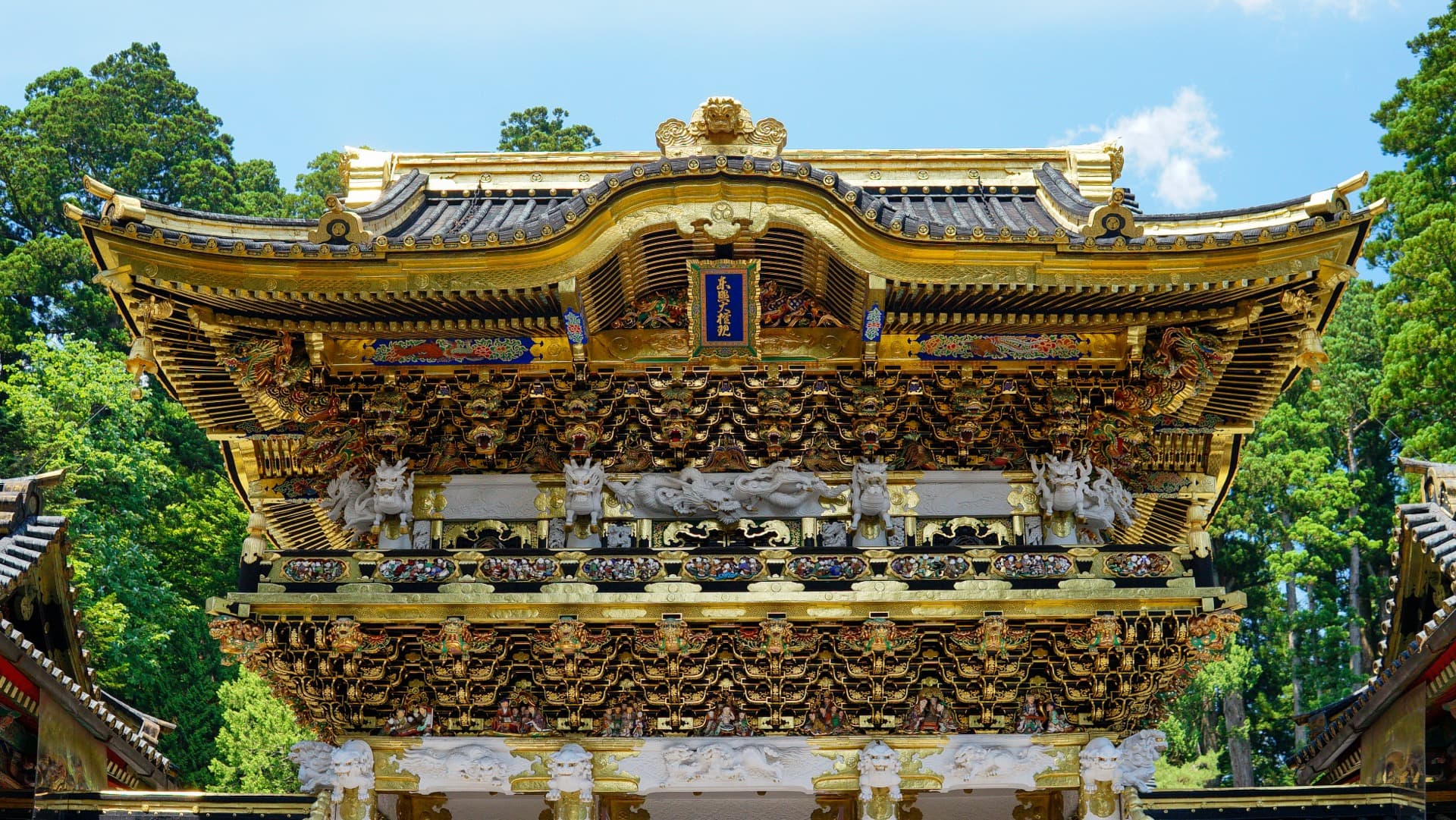
- The Shogun Who Became a God — Why was Tokugawa Ieyasu enshrined as a deity after death? Nikkō Tōshōgū and the man who built 260 years of peace
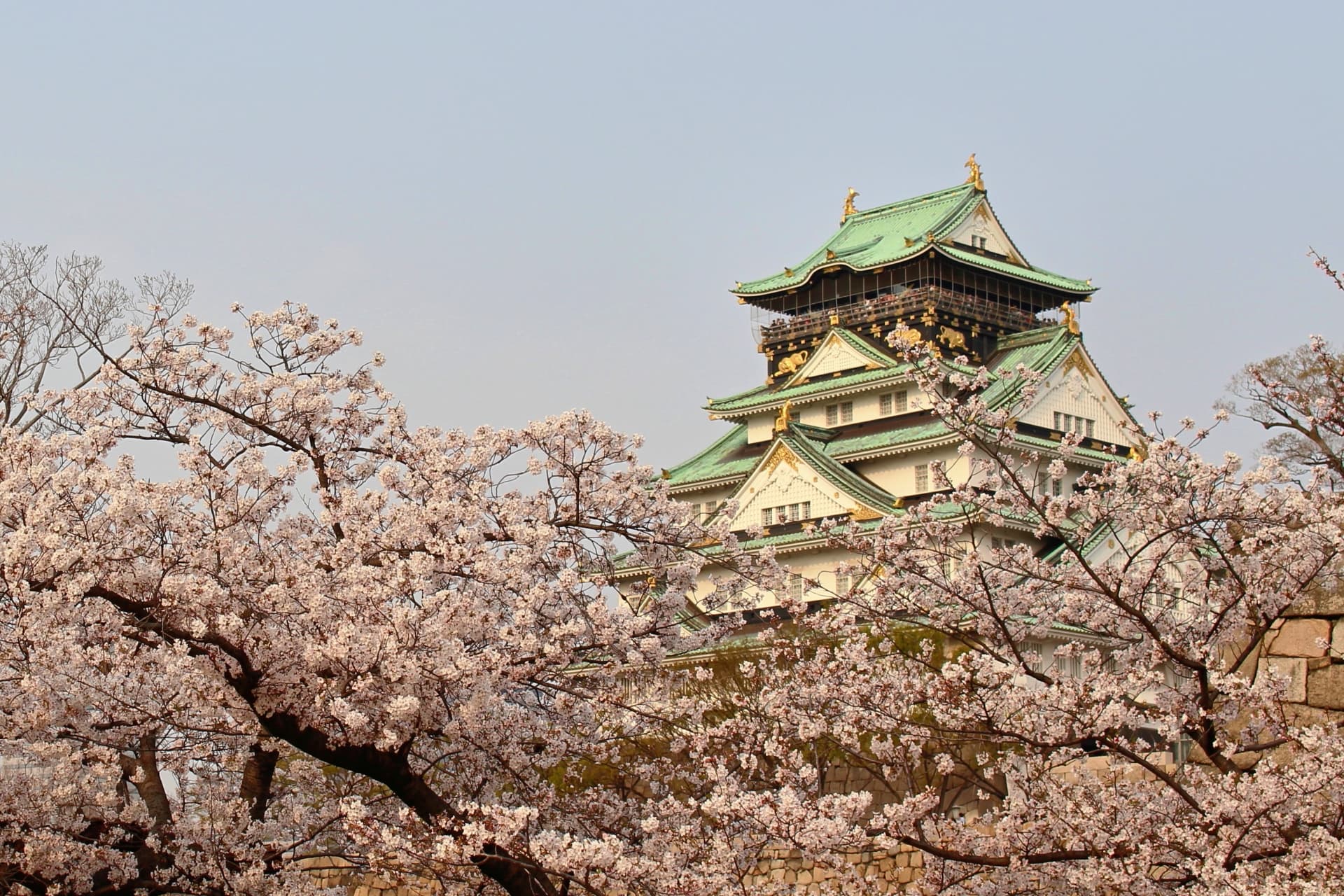
- The Foot Soldier's Son Who Conquered Japan — Toyotomi Hideyoshi. From the lowest rank to supreme ruler. The greatest upset in Japanese history, carved into Osaka Castle
- Why Did Japan's Samurai Commit Seppuku? — The origins of the samurai and bushidō. The warrior age that began on the shores of Kamakura
- The Emperors Who Gave Up Power — Heian-kyō and the Fujiwara clan. When and why authority and power split apart
- 250 Years of Isolation, Then the Black Ships — Japan's modernization, launched from Yokohama Harbor
- The Nation That Built a Railway in 19 Years — Traces of Meiji-era modernization in Tokyo
We strive for historical accuracy in this article, but the author is not a professional historian and some details may be inaccurate. Practical information such as admission fees and opening hours is subject to change — please check official websites for the latest details before visiting.